

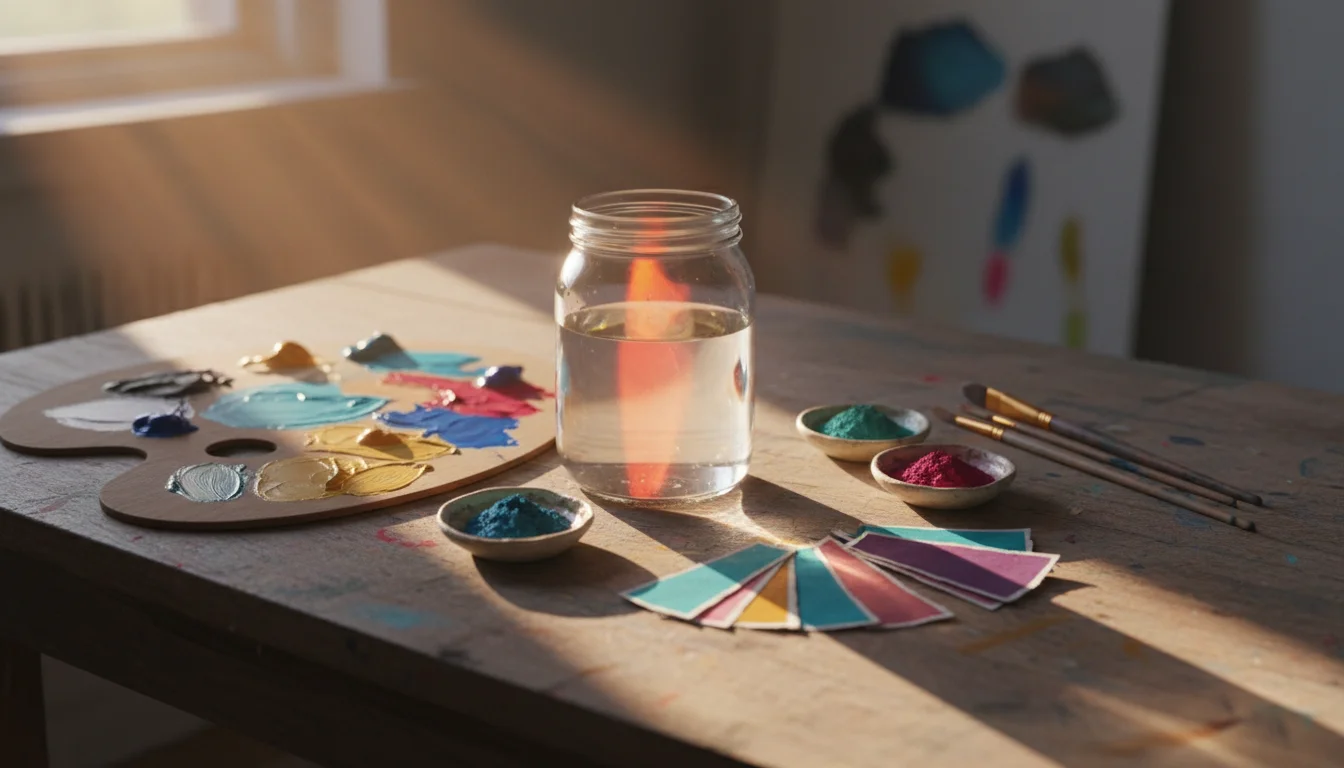
Some mornings the light comes into my Texas studio at an angle that stops me completely. It catches the edge of a jar of water, turns it gold for about ninety seconds, and then moves on. Nobody scheduled it. Nobody would have missed it if I had been looking at my phone. That small, unrepeatable moment is the reason I still paint after more than twenty-five years.
Color was my first language before I had the vocabulary to describe it. Growing up in Azerbaijan, I was surrounded by it, in textiles, in tea glasses, in tiled walls, in the particular blue that the Caspian turns in late afternoon. My training at Azerbaijan State University of Culture and Arts and my mentorship under Arif Aziz taught me how color actually behaves, how one tone pushes another forward or drags it back, how contrast creates not just interest but emotion. That is craft, and craft can be taught.
Seeing is different. Seeing has to be practiced. I have taught art long enough to know that most beginners are not held back by their hands, they are held back by their attention. They paint the idea of a tree instead of the tree in front of them. And honestly, most of us live the same way. We move through days full of texture and light and human faces, and we register almost none of it, because we are already three hours ahead in our minds.
Here is what I have found, and it costs nothing to try. Give five minutes a day to one ordinary thing. A cup on a table. A shadow on a wall. Your child’s hands. Do not photograph it, do not narrate it, just look until you notice something you had not noticed before, which usually takes about ninety seconds longer than feels comfortable. That discomfort is the point. Attention is a muscle, and most of us have let it go soft.
What surprises people is how quickly this changes the mood of a day. Rushing makes everything feel interchangeable. Attention makes things feel specific, and specific things are much harder to be ungrateful for. I cannot look closely at the structure of a feather, the movement of water, or the way a face holds its history and come away unmoved. Creation is not neutral. It is generous, and it is detailed far beyond what function alone would require.
That is what I am always chasing with color contrast and composition. I want a painting to hold light the way a morning holds it, so the work does not sit passively on a wall but keeps offering something back. When I paint a biblical scene, a landscape, or an animal in motion, I am trying to reflect the vitality that was already there. I am a witness, not the source.
This is also why I believe so strongly in living with art rather than just looking at it occasionally. A painting in your home is a standing invitation to pause. You walk past it on a hard Tuesday and it asks you, without saying anything, to slow down for a moment. Screens demand your attention and give you fatigue in exchange. A good painting waits, and gives you something back every time you return to it.
I have had collectors tell me that a piece became the place their eyes go during a difficult phone call, or the thing they look at while their coffee brews, or the first thing guests ask about. That is not decoration. That is a small, daily practice of noticing built quietly into a home. If beauty is a form of testimony, then filling your space with it is not indulgence. It is a way of keeping your heart awake.
You do not need to be an artist to live this way. You just need to decide that the world in front of you is worth your eyes. Look at the sky tonight instead of glancing at it. Notice one color you have never named. See what happens over a week.
If you would like something in your home that keeps calling you back to that kind of attention, I would love to show you what I have been working on. Every piece was made in the hope that someone would stop, look, and feel a little more awake to the beauty they are already living inside.
Browse the collection and find a piece that makes you pause →
Tell me a little bit about your event, and I’ll get back to you within three business days.